"I Don't Have Time" Is the Right Answer to the Wrong Question

"I don't have time" is the right answer to the wrong question.
Nobody has time to evaluate new software. Every practice manager has heard a pitch before and knows exactly how long "quick call" and "just a demo" actually take. The objection is real, and it's reasonable.
But it's answering a different question than the one that actually matters: what is the current process already costing?
Most practices have never actually done this math
Not because the math is hard — because a single letter never feels like the moment worth stopping to calculate. Writing one prior authorization letter doesn't feel like a decision. It's just Tuesday. The cost only becomes visible when you multiply it by real weekly volume, and almost nobody does that multiplication until they're forced to.
So here it is, done plainly.
The per-letter number
Writing a prior authorization letter from scratch — pulling chart notes, matching them to a payer's specific published criteria, formatting it the way a reviewer expects — takes 25 to 45 minutes for someone genuinely good at it. Call it 35 minutes as a working average.
A structured letter, drafted from the same intake information and matched against payer criteria automatically, takes under 10 minutes to review, edit, and approve. That's a 25-minute difference. Per letter. Before appeals enter the picture at all.
What that adds up to across a real week
| PA letters per week | Time at 35 min/letter | Time at under 10 min/letter | Weekly time back |
|---|---|---|---|
| 10 | 5.8 hours | 1.7 hours | ~4 hours |
| 20 | 11.7 hours | 3.3 hours | ~8.3 hours |
| 40 | 23.3 hours | 6.7 hours | ~16.7 hours |
At 20 letters a week — a realistic volume for a busy ortho, pain management, or imaging-heavy practice — that's over a full workday given back, every single week, without counting a single appeal.
Appeals make the math sharper, not softer
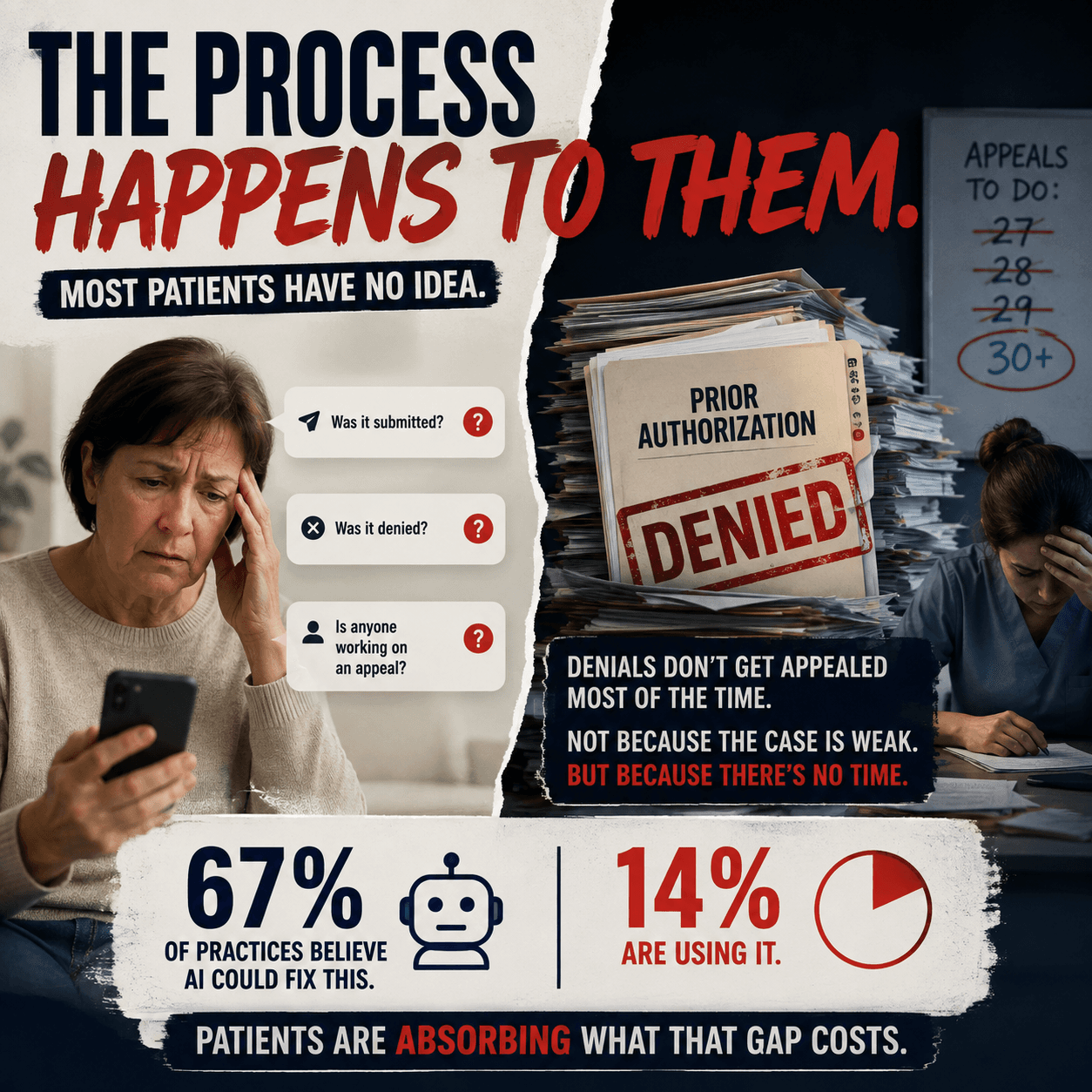
This compounds because of a separate, well-documented gap: roughly 80% of denials are overturned when appealed, but fewer than 11% of practices actually appeal. The usual reason isn't doubt about winning. It's that writing the appeal takes the same 25-45 minutes the original letter did, stacked on top of an already full week.
If even a modest share of unwritten appeals get written once the time cost drops from 35 minutes to under 10, that's not abstract efficiency — it's revenue that was already earned and never collected, sitting behind a time barrier that no longer has to exist.
Why the objection doesn't actually hold up here
Here's the asymmetry worth naming directly: evaluating whether a faster process works costs a small fraction of what one week of the old process costs. A pilot built around 10 real letters — not a hypothetical, the actual next 10 — takes less time to run than a single afternoon of manual drafting, and shows the time difference directly, on real cases, before anything gets decided.
"I don't have time" is true about a lot of things a practice gets pitched. It's not actually true about looking at ten letters.
The honest bottom line
This isn't a sales argument dressed up as arithmetic. It's just what 25 minutes, multiplied by a real weekly volume, comes out to. Whatever tool a practice ends up choosing, running this calculation for its own actual PA volume is worth ten minutes on its own — most practices have simply never seen the number written down.
If you want to see the difference on your own next 10 letters rather than a hypothetical, asaanbil.com runs a free pilot, no card required. asaanbil.com (https://asaanbil.com)
Comments (0)
Sign in to like or comment.
No comments yet.